Location
CHF individual portfolios
EUR Individual portfolios
Ethics Committee
Sustainable investment
More than 200 criteria are used in the ethical assessment of issuers, which are systematically analyzed for companies or countries.
The PRIME VALUES Ethics Committee’s strict assessment procedure has been continuously refined over the past 30 years. From the outset, a combination of exclusion and positive criteria has been used unchanged. The procedure is described in detail in the Eurosif Transparency Guideline.
The assessment of companies/issuers from an ethical perspective is based on clear exclusion criteria and ethics analysis in order to enable a selection of proactive companies.
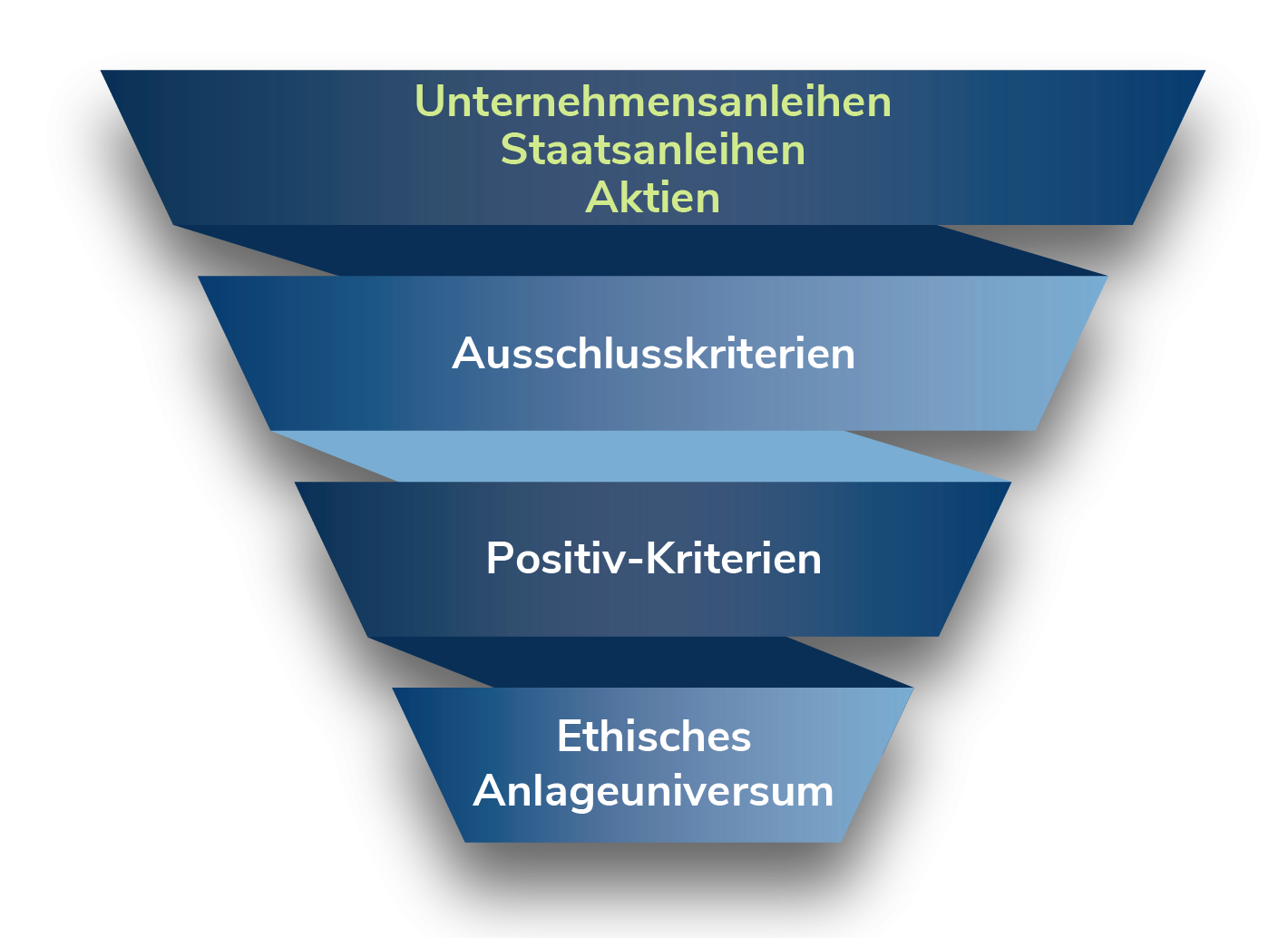
Investors’ capital is made available to issuers that promote the following principles:
These principles are concretized in defined exclusion and positive criteria.
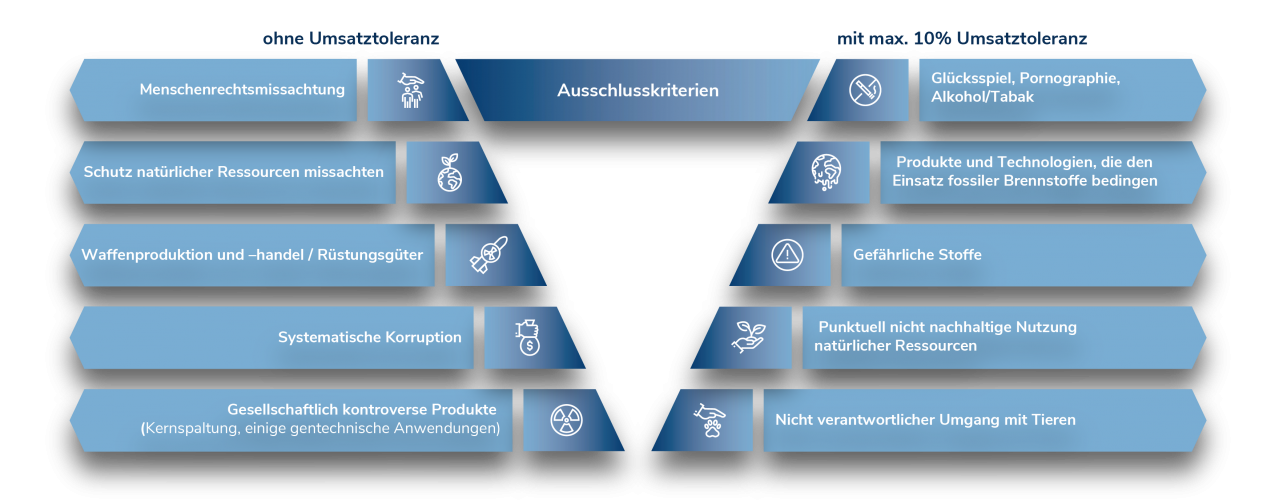
Exclusion criteria are used for pre-selection and exclude issuers that do not meet the defined exclusion criteria (in accordance with the above-mentioned principles). If an issuer violates one or more exclusion criteria, it is not analyzed further. If the analysis reveals a violation of exclusion criteria, the security is excluded from the investment universe.
At the heart of every issuer analysis are the positive criteria. Thanks to these, issuers can be assessed from an ethical and sustainable perspective. A company can achieve a maximum of 100 points. To qualify for inclusion in the investment universe, a company must score at least 50 points. Various predicates are assigned to the points scale for better understanding:
<50 points: not justifiable – excluded
50-65 points: justifiable
66-80 points: positive
>81 points: high quality
The analysis from an ethical perspective focuses on five detailed questions for companies.
Five ethical perspectives | Criteria | ||
|---|---|---|---|
1. understanding of responsibility | a) Declared self-image b) Profit orientation c) Corporate governance d) Management principles e) Stakeholder concept and social commitment | ||
2. offer (products and services) | a) Business model b) Customer benefit c) Consumer protection d) Sense and legitimacy from a societal-social perspective e) Sense and legitimacy from an ecological perspective | ||
3. processes | a) Production b) Customers c) Employees d) Suppliers e) Management systems | ||
4. protection of natural resources | a) Policy (environmental guideline) b) Operational ecology c) Value chain (from an ecological perspective) d) Products (product ecology) e) Innovation and proactivity | ||
5. transparency and reputation | a) Image of the company b) Information (information density, depth) c) Controversies d) Corruption, bribery e) Reputation | ||
Exclusion criteria:
Currently non-investable government bonds, including:
France, UK, USA, Finland, China
The country assessment is based exclusively on exclusion criteria and relates solely to government bonds (not to the companies operating in the respective countries).